What Is Values-Based Investing and How Is It Different From Traditional Wealth Management

What Is Values-Based Investing and How Is It Different From Traditional Wealth Management
For most of the modern financial era, wealth management has operated on a relatively straightforward premise: grow the money, manage the risk, and optimize the return. These goals are legitimate and important. But we believe that for a growing number of investors, they represent only part of the picture.
Values-based investing introduces a broader set of questions into the financial conversation. Not just how much can this portfolio return, but what is it funding along the way? Not just how do I protect my wealth, but what kind of world does my wealth help create?
This is the foundation of holistic financial advice as we practice it at Holistic Finance. It is an approach that takes your financial goals seriously and places them alongside your values, your priorities, and your vision for the future. In this article we explore what values-based investing actually means, how it compares to traditional wealth management, and why so many investors are finding this approach to be a more complete way of engaging with their money.
What Traditional Wealth Management Typically Focuses On
As we understand it, traditional wealth management is built around a core set of objectives: asset allocation, portfolio diversification, risk-adjusted returns, and tax efficiency. A conventional financial advisor may typically assess your risk tolerance, your time horizon, and your income needs, and then construct a portfolio designed to maximize performance within those parameters.
This model has served many investors well over the decades. The tools it uses, including modern portfolio theory, diversification across asset classes, and disciplined rebalancing, are grounded in decades of research and practice.
What traditional wealth management has not historically prioritized is the question of what the underlying investments are actually doing in the world. A conventional portfolio built around broad index funds may contain hundreds or even thousands of companies. Some of those companies may be doing genuinely positive work. Others may be involved in industries that the investor would not consciously choose to support, including fossil fuel extraction, weapons manufacturing, factory farming, private prison operations, or practices that raise concerns around labor rights and environmental harm.
In the traditional model, these considerations have generally been treated as separate from the financial conversation. Holistic financial advice brings them into the same room.
What Values-Based Investing Actually Means
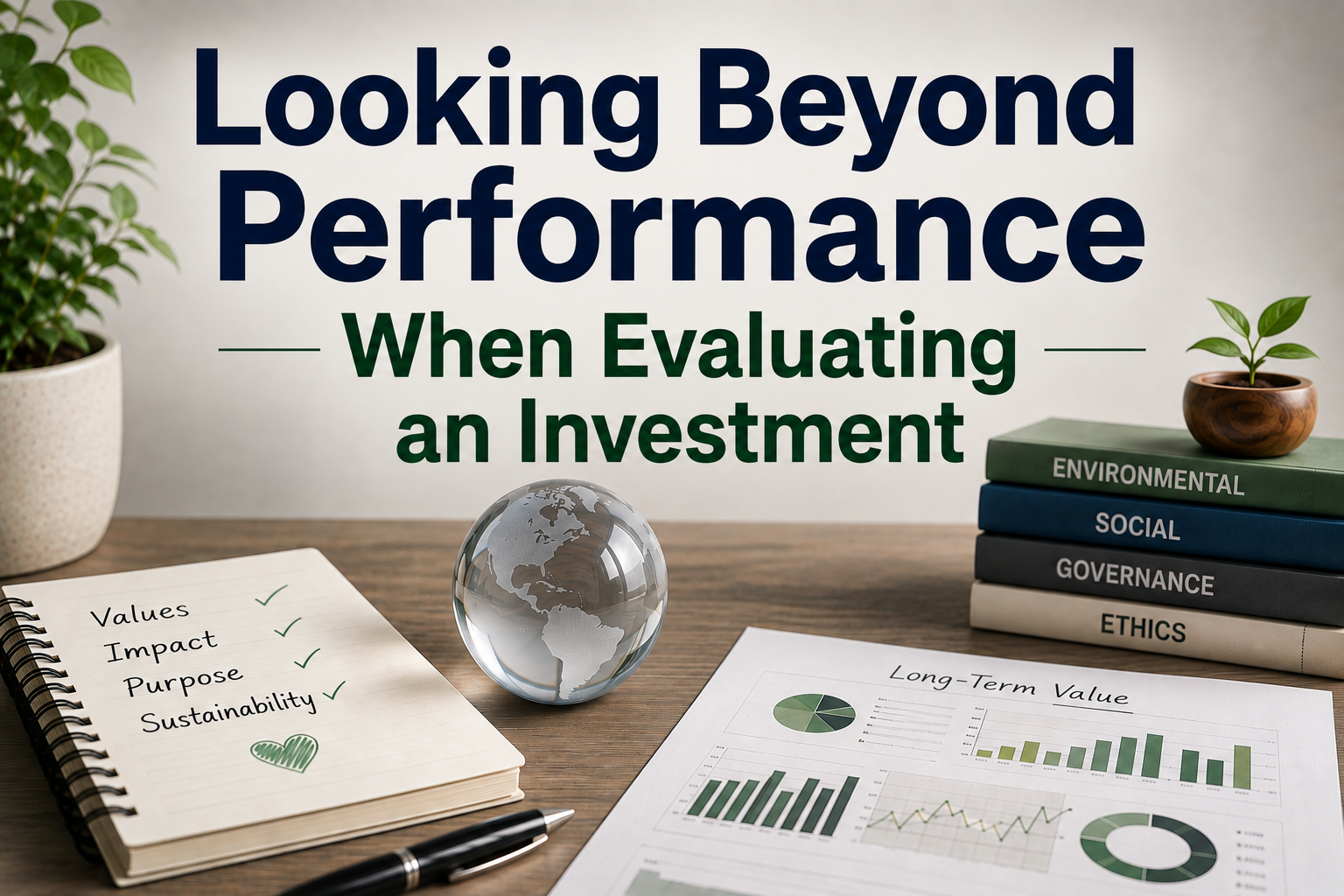
For us, values-based investing is an approach to portfolio construction that intentionally aligns an investor's capital with their personal values, ethical priorities, and vision for the world. Rather than selecting investments purely on the basis of financial metrics, a values-based strategy incorporates social, environmental, and ethical criteria into the selection process alongside traditional financial analysis.
This can take several forms. At the most basic level, it may involve screening out industries or companies that conflict with an investor's values. At a more sophisticated level, it involves actively seeking out and selecting companies that are demonstrating leadership in areas the investor cares about, whether that is clean energy, regenerative agriculture, ethical labor practices, community health, or environmental stewardship.
At Holistic Finance, we believe the most meaningful version of values-based investing goes further than simply removing the worst actors from a portfolio. Our approach involves identifying what we consider to be the best companies in each sector using both quantitative financial metrics and qualitative ethical assessments. Each company in our portfolio is evaluated across dozens of ethical categories and monitored on an ongoing basis for both financial and ethical performance.
We want our clients to be able to look at their portfolio and recognize it as a genuine reflection of what they stand for.
How Values-Based Investing Differs From ESG
It is worth addressing ESG here, because the two are often conflated. ESG stands for Environmental, Social, and Governance, and it refers to a set of criteria that some fund managers may use to evaluate companies. ESG has become increasingly mainstream over the past decade, and many large financial institutions now offer ESG-labeled funds.
In our opinion, ESG is a starting point, not a destination. ESG ratings may be applied inconsistently across the industry, and the methodology varies significantly from one rating agency to another. A 2022 study published in the Review of Finance found substantial disagreement among major ESG rating agencies, with correlations between providers averaging around 0.54, which is notably low for what are meant to be standardized assessments. Source: (Berg, F., Kolbel, J., and Rigobon, R. Aggregate Confusion: The Divergence of ESG Ratings. Review of Finance, 2022.)
ESG funds may also still contain significant exposure to industries that a values-conscious investor would find objectionable, because the ESG label typically involves exclusions at the margins rather than a ground-up rethinking of the portfolio. Holistic financial advice, as we practice it, involves building a portfolio around a client's actual values rather than applying a label to a conventional fund.
Why Ethical Investing and Financial Performance Are Not Necessarily in Conflict
One of the most common concerns we hear from investors exploring values-based investing is whether aligning their portfolio with their ethics will cost them financially. This concern is understandable, and it deserves a direct answer.
Research has increasingly suggested that companies with strong social and environmental practices may also be strong financial performers. A meta-analysis published in the Journal of Sustainable Finance and Investment reviewed more than 2,000 empirical studies and found that the majority showed a positive relationship between ESG performance and corporate financial performance. Source (Friede, G., Busch, T., and Bassen, A. ESG and Financial Performance: Aggregated Evidence From More Than 2000 Empirical Studies. Journal of Sustainable Finance and Investment, 2015.)
There are several reasons this relationship may exist. Companies that are careful stewards of environmental resources may also be more efficient in their use of energy and materials, and that efficiency can carry over into other areas of business management. Companies that treat their employees well tend to benefit from higher morale, lower turnover, and stronger organizational loyalty, factors that can support long-term performance. And companies that anticipate regulatory trends around environmental and social responsibility may be better positioned to manage compliance costs as those trends accelerate.
We believe that carefully selected values-aligned investments can contribute to both financial performance and positive impact. All investing involves risk, and past performance is never a guarantee of future results. We encourage every investor to consult with a licensed advisor before making any financial decisions.
Who Holistic Financial Advice Is Designed For
Values-based investing can be a meaningful option for a wide range of investors, but we believe it tends to resonate most strongly with people who have arrived at a particular moment of awareness. People who have accumulated wealth, and begun to notice a disconnect between the values they live by and the systems their money is quietly funding.
Our clients at Holistic Finance often include people working in healing professions, education, community advocacy, and the arts. Many have inherited wealth and want to use it in a way that feels purposeful. Some have been in conventional investment systems for years and have grown uncomfortable with what those systems may be supporting without their knowledge. Others simply want the peace of mind that comes with knowing their portfolio reflects who they truly are.
In our view, holistic financial advice is for anyone who feels that their financial life and their inner life deserve to be telling the same story. You do not need to be an activist or an expert in environmental policy. We invite you to care about the future with a team that takes that seriously.
What the Holistic Finance Client Experience May Look Like
Our approach to holistic financial advice integrates four key dimensions. Comprehensive financial planning that brings together retirement, risk, estate, cash flow, and legacy planning in a way that reflects your values alongside your financial goals. Custom investment portfolios built from the ground up and aligned with your ethical and financial priorities, with real-time performance metrics for both. Access to private impact investments in non-listed companies that may deliver positive social and environmental outcomes across a range of return expectations. And ongoing mentorship and education to help you grow as an investor over time.
We serve clients who are ready to steward assets of at least $100,000 with intention. Our team is led by licensed professionals with a fiduciary obligation, which means we are legally required to act in your best interest.
Conclusion
Values-based investing and traditional wealth management share many of the same foundational tools and goals. Where they differ is in the scope of what may count as a potentially more meaningful outcome. Traditional wealth management measures success primarily in financial terms. Holistic financial advice measures it in financial and human terms, because we believe both dimensions matter and both deserve thoughtful attention.
If you are curious about what a more values-aligned approach to investing may look like for your specific situation, we invite you to get started today.
Visit holisticfinance.com to learn more and schedule your complimentary call. Your future is waiting.
Disclosures
Advisory services are offered through Holistic Finance LLC an SEC Investment Advisor. Registration does not imply a certain level of skill or training. This article is for informational and educational purposes only and does not constitute investment, tax, or legal advice. References to specific financial institutions are for example purposes only and do not constitute endorsements or recommendations.