The Difference Between Socially Responsible Investing, ESG, and True Values-Based Investing
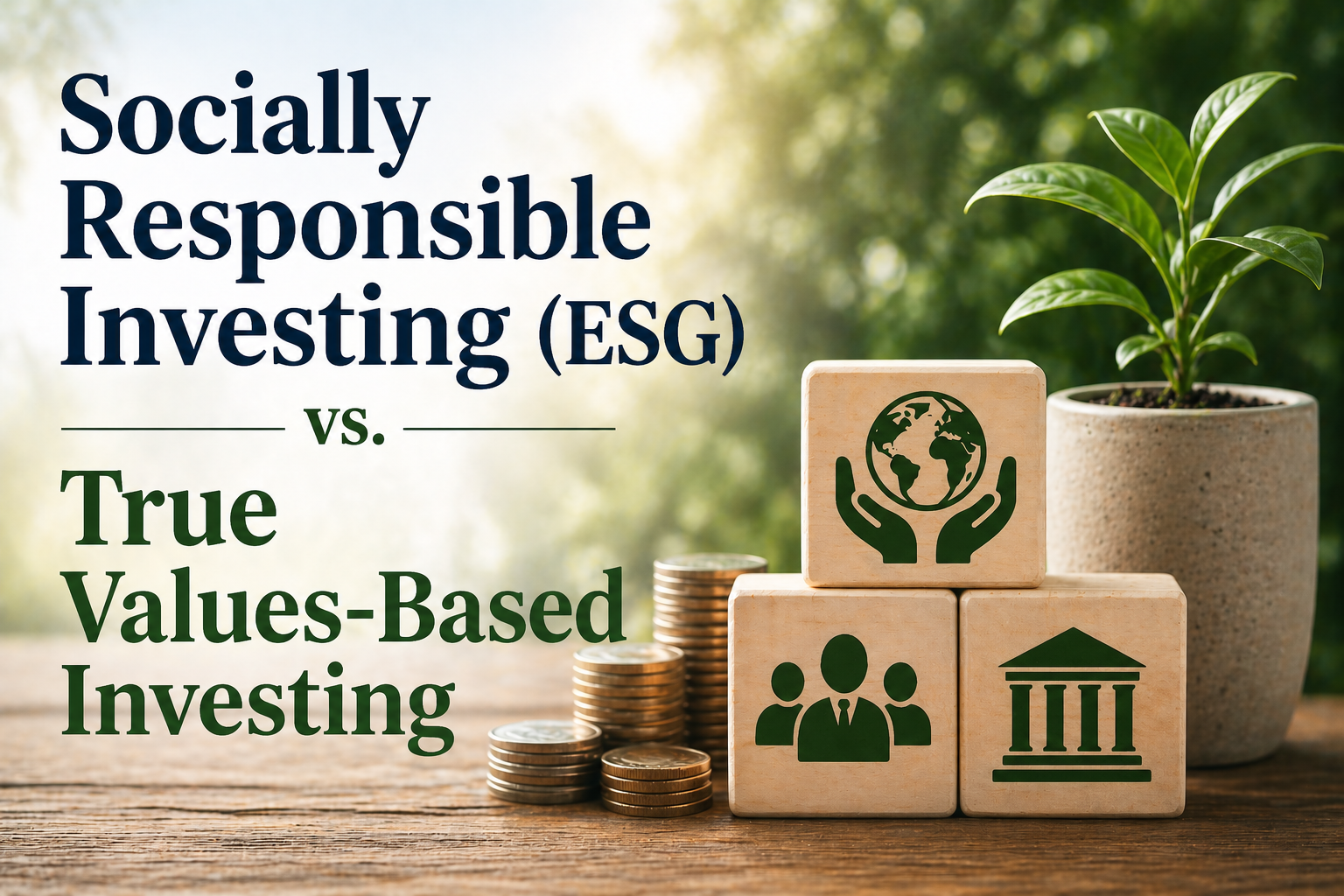
The Difference Between Socially Responsible Investing, ESG, and True Values-Based Investing
For investors exploring holistic financial services, values-based investing can sometimes feel confusing because terms like socially responsible investing, ESG, sustainable investing, and impact investing are often used interchangeably. In our view, that can create misunderstanding. While these approaches may overlap, they are not always the same.
Socially Responsible Investing, often called SRI, has historically focused on excluding certain companies or industries from a portfolio based on ethical, religious, environmental, or social concerns. US SIF describes sustainable investing as including strategies such as ESG incorporation and shareholder engagement, while earlier approaches often emphasized screening investments based on values or concerns. Source
A simple way to understand SRI is this: an investor may choose not to own companies connected to tobacco, weapons, fossil fuels, gambling, or other areas they personally object to. That does not necessarily mean every SRI portfolio uses the same exclusions. We believe this is one reason a clear conversation between an advisor and client is essential.
ESG, by contrast, generally refers to the use of environmental, social, and governance factors in investment analysis. CFA Institute describes ESG investing as integrating environmental, social, and governance factors into investment decisions. Source FINRA has similarly explained that ESG strategies may use environmental, social, and governance criteria in selecting investments that aim to create competitive financial return and positive social impact. Source
In plain terms, ESG may ask questions such as: How does a company manage climate-related risks? How does it treat employees, suppliers, or communities? How independent is its board? How transparent is its leadership? These factors may be relevant because they could potentially affect long-term business risk, reputation, regulation, litigation, or profitability.
However, ESG does not always mean a portfolio perfectly reflects a client’s personal values. A company may score well on certain governance or environmental metrics while still operating in an industry a client would personally avoid. This is why we believe ESG should not automatically be treated as the same thing as true values-based investing.
True values-based investing, as we understand it, starts with the investor’s values first. Rather than beginning only with a fund label or third-party rating, it can ask deeper questions: What do you want your money to support? What do you want to avoid? Which trade-offs are acceptable? Which are not? How should your investments coordinate with your broader financial plan, charitable giving, retirement needs, tax strategy, family goals, and risk tolerance?
This is where holistic financial services may matter. In our view, a holistic approach does not look at a portfolio in isolation. It looks at the whole person, the whole household, and the whole financial life. That may include investments, insurance, retirement planning, estate planning coordination, tax-aware strategies, giving goals, business interests, family priorities, and personal convictions.
The distinction may matter because investment labels can be imperfect. The SEC adopted amendments to its fund “Names Rule” in 2023 to address concerns that fund names could mislead investors about a fund’s investments and risks. Source The rule modernization included attention to terms suggesting a thematic or characteristics-based investment focus, including ESG-related terms. Source As we understand it, this regulatory attention suggests investors should not rely on a fund name alone when deciding whether a product aligns with their values.
That does not necessarily mean ESG or SRI funds are inherently problematic. Rather, it means they may require due diligence. Investors may want to review a fund’s prospectus, holdings, methodology, exclusions, engagement practices, fees, risks, and performance history before assuming it matches their beliefs. We believe this review can be especially important for clients seeking holistic financial services because their goal may be broader than simply choosing a product with a sustainable-sounding name.
Another important difference is the role of shareholder engagement. US SIF identifies shareholder resolutions on ESG issues as one of the major sustainable investing strategies it tracks. Source In practice, some investors may choose to own certain companies and use proxy voting or engagement to encourage change. Others may prefer divestment or exclusion. Neither approach is universally right for every investor, and each may involve trade-offs.
Performance expectations also deserve care. We do not believe that any one investment approach can guarantee better returns, lower risk, or stronger alignment in every market environment. ESG, SRI, and values-based portfolios can perform differently from broad market indexes because they may include or exclude different companies, sectors, or factors. We believe investors should evaluate whether any values-based strategy remains consistent with their financial objectives, time horizon, income needs, tax situation, and risk capacity.
Fees and diversification also matter. A values-aligned portfolio that is too concentrated, too expensive, or poorly matched to a client’s goals may create challenges. In our view, true values-based investing should not ignore financial fundamentals. It should seek to integrate values with prudent planning.
For example, an investor may want to avoid fossil fuel companies. That may be possible, but the investor should understand how that exclusion could affect sector exposure, tracking error, volatility, and long-term planning assumptions. Another investor may want to support companies with strong labor practices or board diversity. That may require reviewing fund methodology and holdings rather than relying only on an ESG score.
This is also why values-based investing can be deeply personal. Two investors may both care about sustainability but define it differently. One may prioritize climate change. Another may prioritize faith-based exclusions. Another may focus on affordable housing, racial equity, local community investment, animal welfare, or corporate transparency. We believe holistic financial services should create room for that nuance instead of forcing every client into the same model.
A practical framework may help:
First, define what matters most. We believe investors should identify their non-negotiables, preferences, and areas where they are comfortable with compromise.
Second, understand the strategy. Is the portfolio using exclusions, ESG integration, positive screening, impact investments, shareholder engagement, or some combination?
Third, review the holdings. A label may not tell the whole story, and the underlying investments may matter more than the marketing language.
Fourth, evaluate financial fit. The strategy should still be considered in light of risk tolerance, goals, time horizon, liquidity needs, taxes, fees, and diversification.
Fifth, revisit regularly. Values, markets, regulations, and fund methodologies can change over time, so ongoing review may be appropriate.
At Holistic Finance, we believe true values-based investing should be both personal and disciplined. It should not simply ask, “Is this fund labeled ESG?” It should ask, “Does this financial strategy reflect who you are, what you care about, and what you are trying to build?”
In summary, SRI may focus heavily on avoiding certain investments. ESG may focus on incorporating environmental, social, and governance factors into investment analysis. True values-based investing may go deeper by aligning financial decisions with the investor’s personal convictions and overall life plan.
For people seeking holistic financial services, that deeper alignment may be the real goal: not just investing in a way that sounds responsible, but building a financial life that feels intentional, informed, and connected to your values.
Disclosures
Advisory services are offered through Holistic Finance LLC an SEC Investment Advisor. Registration does not imply a certain level of skill or training. This article is for informational and educational purposes only and does not constitute investment, tax, or legal advice. References to specific financial institutions are for example purposes only and do not constitute endorsements or recommendations.