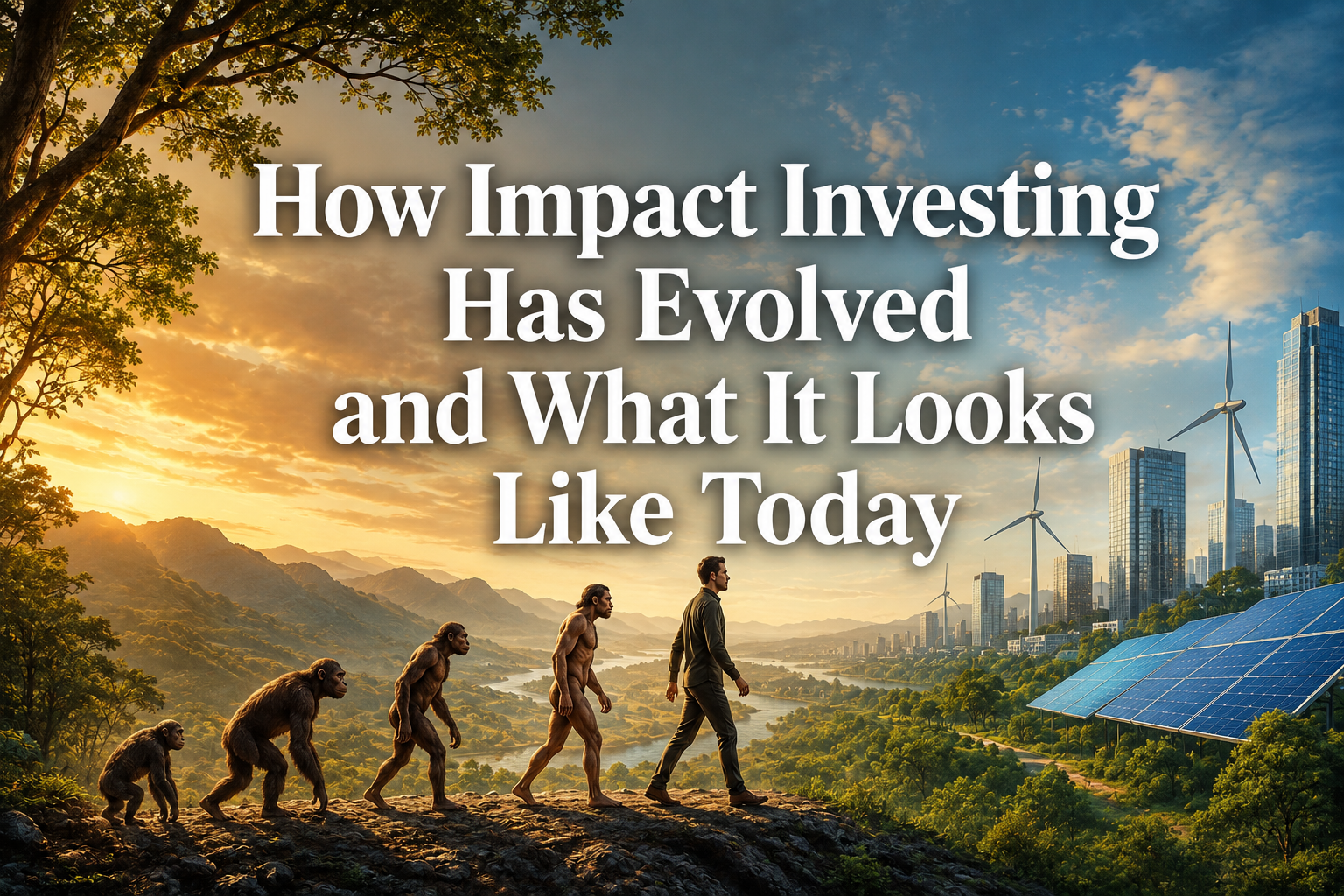
How Impact Investing Has Evolved and What It Looks Like Today
How Impact Investing Has Evolved and What It Looks Like Today
Introduction
Impact investing, as we understand it, is no longer only a niche conversation among philanthropists and mission-driven institutions. The Global Impact Investing Network, or GIIN, defines impact investments as investments made with the intention to generate positive, measurable social and environmental impact alongside a financial return. Source For investors exploring values based investing, this definition may be useful because it emphasizes both intentionality and measurement.
The phrase “impact investing” was shaped through Rockefeller Foundation convenings in 2007, and the GIIN was created in 2009. Source In our view, this history matters because it suggests the field developed from a desire to move beyond charitable giving alone and consider whether investment capital could also be directed toward social or environmental outcomes.
Understanding Impact Investing Today
Today, impact investing may sit within a broader universe that can include ESG investing, sustainable investing, socially responsible investing, faith-aligned investing, shareholder advocacy, community investing, and other forms of values based investing. Investors should understand that these approaches are not identical. GIIN describes credible impact investing through core characteristics that include intentionality, financial return expectations, a range of asset classes and return expectations, and impact measurement. Source
The market has also become more substantial. GIIN estimated that more than 3,907 organizations managed $1.571 trillion in impact investing assets worldwide in its 2024 market sizing report. Source Separately, US SIF reported $6.5 trillion in total U.S. sustainable investment assets under management at the beginning of 2024, representing 12 percent of total U.S. assets under professional management. Source These figures do not prove that any specific strategy is suitable for any specific investor, but they may indicate that values based investing has become a more visible part of the investment landscape.
Increased Scrutiny and Regulation
As the field has grown, scrutiny may have grown as well. The SEC adopted amendments to the Investment Company Act “Names Rule” in 2023 to address fund names that could mislead investors about a fund’s investments and risks. Source We believe this regulatory focus is important because investors may otherwise assume that a fund with terms like “sustainable,” “ESG,” or “impact” automatically aligns with their personal values or expected outcomes.
What Impact Investing Looks Like in Practice
What does impact investing look like today? In practice, it may include public market funds, private funds, community development financial institutions, green bonds, affordable housing strategies, renewable energy finance, gender lens investing, or investments tied to health, education, or financial inclusion. This range should not be read as a recommendation. Rather, it may illustrate why investors often need careful due diligence before choosing a values based investing approach.
Measurement may be one of the biggest differences between general values alignment and impact investing. GIIN’s framework emphasizes impact measurement as a core characteristic. Source As we understand it, an investor might ask whether a strategy clearly defines its intended impact, explains how impact data is collected, and reports outcomes in a way that can be evaluated over time.
Financial Return and Impact
At the same time, we believe financial considerations still matter. GIIN’s definition includes the expectation of financial return alongside measurable impact. Source We believe investors should avoid assuming that every impact strategy has the same risk, liquidity, cost, tax profile, or return objective. A private impact fund may behave very differently from a publicly traded mutual fund or ETF.
The Push for Transparency
Another evolution may be the growing demand for transparency. IFC launched the Operating Principles for Impact Management in 2019 as a market standard for investors seeking measurable, positive impact alongside financial returns. Source In our view, frameworks like this can potentially help investors compare managers, although they do not guarantee investment performance or impact outcomes.
Recent fund-flow data also suggests that sustainable investing demand can fluctuate. Morningstar reported that global sustainable open-end and exchange-traded funds recorded estimated net outflows of $27 billion in the fourth quarter of 2025. Source This may remind investors that values based investing is still subject to market cycles, investor sentiment, regulatory developments, and performance concerns.
Questions Investors May Want to Consider
For individuals, the modern conversation may be less about choosing between “doing good” and “doing well,” and more about clarifying tradeoffs. We believe a thoughtful process may start with questions such as:
- Which values matter most?
- Which issues should be included or excluded?
- Is the investor seeking broad ESG integration, targeted impact, faith alignment, shareholder engagement, or community-level outcomes?
- What evidence would show that the strategy is doing what it claims?
Investors may also want to review costs, diversification, liquidity, tax implications, manager experience, proxy voting practices, and reporting methods. We believe none of these factors should be ignored simply because a strategy uses values-oriented language. But values-based investing should still be evaluated through the same disciplined planning lens as any other investment approach.
Conclusion
Impact investing has evolved from an emerging term into a broader, more structured field with market data, industry frameworks, and regulatory attention. Based on cited industry definitions, it appears to center on intentional, measurable impact alongside financial return. Source For investors who care about aligning money with purpose, values-based investing may offer a meaningful path, provided the strategy is carefully reviewed, accurately understood, and aligned with the investor’s broader financial plan.
Disclosures
Advisory services are offered through Holistic Finance LLC an SEC Investment Advisor. Registration does not imply a certain level of skill or training. This article is for informational and educational purposes only and does not constitute investment, tax, or legal advice. References to specific financial institutions are for example purposes only and do not constitute endorsements or recommendations. Incorporating a social objective or other non-financial objective into investment decisions will result in investment recommendations that are not only focused on maximizing a financial return.