How to Talk to Your Financial Advisor About Values Without Being Dismissed

How to Talk to Your Financial Advisor About Values Without Being Dismissed
For many people, investing may be about more than growing wealth. It may also be about supporting companies, industries, and business practices that reflect personal priorities. If you have ever felt hesitant to bring those priorities into a conversation with your financial advisor, it’s possible you are not alone.
We believe that discussing your values should be a normal part of comprehensive financial planning. The conversation does not need to be confrontational, political, or emotional. Instead, it can become an opportunity to clarify what matters most to you and how those preferences may fit within your broader financial goals.
If you are interested in social responsible investment, knowing how to communicate your priorities clearly may help create a more productive relationship with your advisor.
Start With Your Personal Goals
Before discussing investment options, it may help to define what "values" actually means to you.
As we understand it, different investors may have very different priorities. For one person, it could involve avoiding certain industries. Another investor may prefer supporting companies involved in renewable energy, healthcare innovation, community development, or improved labor practices. Others may simply want greater transparency about what they own.
Rather than beginning with specific investments, consider explaining what outcomes matter most to you.
For example, you might say:
"I'd like my investments to better reflect my personal values."
"Can we discuss whether my current portfolio aligns with industries I want to avoid?"
"I'd like to understand what socially responsible investment options may be available.”
These statements can invite collaboration rather than conflict.
Understand That Responsible Investing Includes Different Approaches
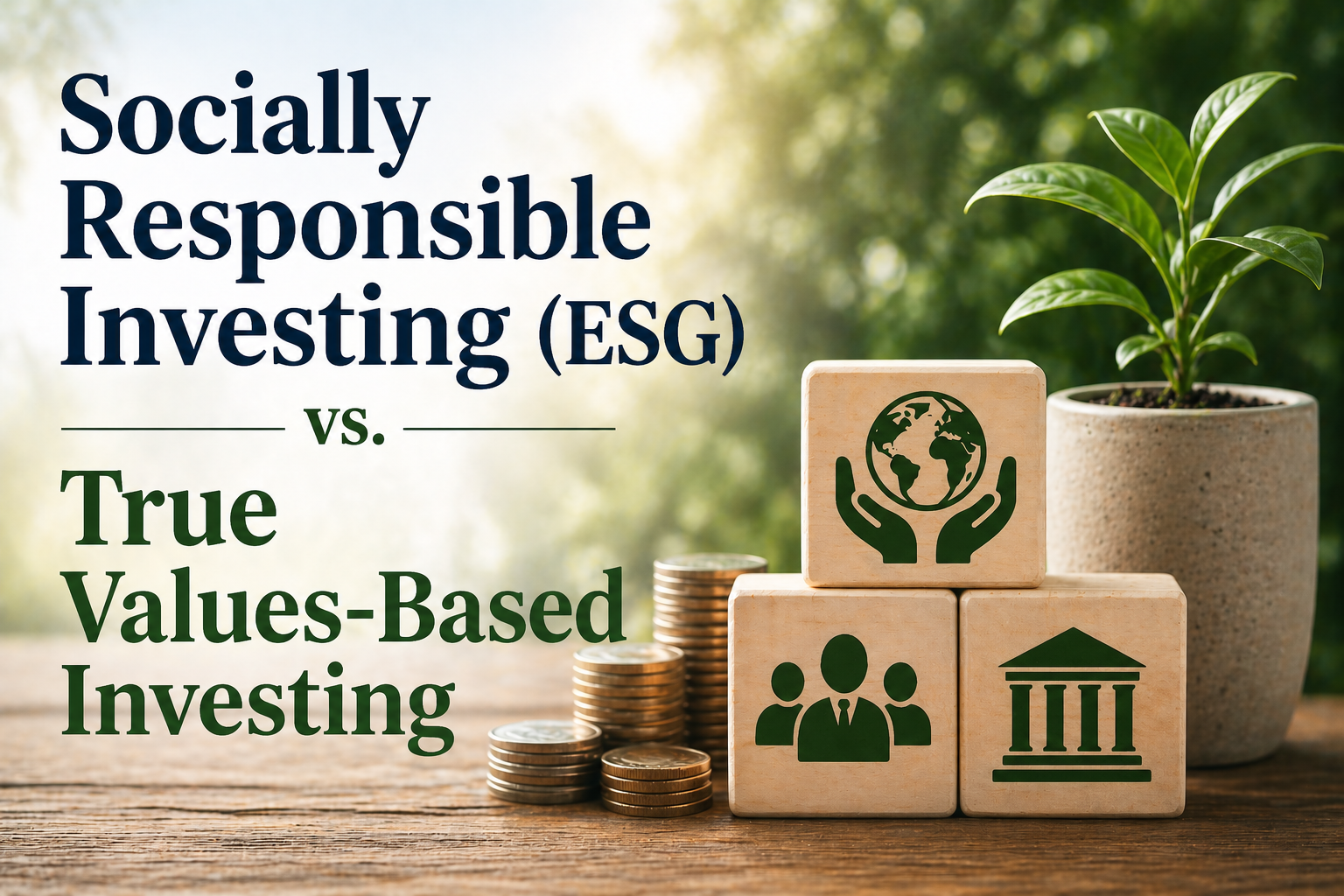
Many investors may use terms like ESG investing, sustainable investing, impact investing, and social responsible investment interchangeably. However, these approaches can mean different things.
The CFA Institute, the Global Sustainable Investment Alliance (GSIA), and the Principles for Responsible Investment (PRI) collaborated to develop common definitions for responsible investment approaches in order to improve consistency in the industry. Their guidance defines approaches such as screening, ESG integration, thematic investing, stewardship, and impact investing. According to the organizations, standardized terminology can improve communication among investors and financial professionals.
Having a basic understanding of these differences may make conversations with your advisor more productive because you can better describe what you are actually seeking.
Ask Questions Instead of Making Assumptions
We believe that many advisors genuinely want to understand what matters to their clients. Sometimes the challenge is simply that the conversation never happens.
Instead of assuming your advisor will dismiss your concerns, consider asking thoughtful questions such as:
- How do you currently evaluate responsible investment options?
- Do you offer portfolios that incorporate investor values?
- What screening methods are available?
- How do you balance investment objectives with client preferences?
- How do you document a client's investment preferences?
These questions encourage discussion rather than debate.
Explain Why Your Values Matter
Every financial plan is unique because every investor is unique.
Your advisor may already consider factors like retirement goals, time horizon, liquidity needs, tax considerations, and risk tolerance. And as we understand it, personal values may simply become another important preference to discuss.
You do not necessarily need to justify your beliefs. Instead, explain why they matter to you.
For example:
"I feel more comfortable investing this way."
"I want my portfolio to reflect my long term priorities."
"I would like to better understand what companies I own.”
This helps shift the conversation from opinions to client preferences.
Ask for Transparency
One reason investors may become frustrated is that they often do not know exactly what they own.
If social responsible investment is important to you, consider asking your advisor for greater transparency.
You might ask:
- What funds are currently in my portfolio?
- What screening process is used?
- How are companies selected?
- Are there industries that are intentionally excluded?
- How often are portfolios reviewed?
Greater transparency may help you make more informed decisions while also helping your advisor better understand your expectations.
Recognize That Perfect Alignment May Not Exist
We believe it is important to approach responsible investing with realistic expectations.
Large investment funds can own hundreds or even thousands of securities. Because companies operate through complex supply chains and multiple business segments, achieving perfect alignment with every personal value may not always be possible.
This does not necessarily mean your goals cannot be pursued. Instead, it may mean discussing priorities and tradeoffs with your advisor.
For some investors, avoiding a small number of industries may be sufficient.
Others may seek portfolios emphasizing specific themes.
Still others may prioritize shareholder engagement or stewardship.
The right approach can depend on each individual's financial goals and preferences.
Keep the Conversation Collaborative
Financial planning generally works best when clients and advisors communicate openly.
Instead of approaching the discussion as a disagreement, it may help to frame it as a planning conversation.
For example:
"I'd like to understand what options exist for incorporating my values into my investment strategy."
That wording invites collaboration rather than placing the advisor in a defensive position.
According to the CFA Institute, sustainable investing "balances traditional investing with environmental, social, and governance-related (ESG) insights to improve long-term outcomes." The same article explains that sustainable investing builds upon traditional investment concepts rather than replacing them.
Remember That Your Preferences Are Part of Financial Planning
As we understand it, financial planning is ultimately about helping clients pursue their personal objectives.
If charitable giving, retirement timing, tax efficiency, estate planning, or education funding are appropriate planning discussions, then investment preferences may also deserve thoughtful consideration.
The CFA Institute Research Foundation has stated:
"Socially responsible investment (SRI) is not limited to community investing and exclusion screening. It is, in fact, an investment approach driven by the values and beliefs of the investor."
That perspective reinforces the idea that investors may legitimately wish to discuss personal values alongside financial objectives.
Finding the Right Advisor
If conversations repeatedly leave you feeling unheard, it may be worth asking whether your advisor's philosophy matches your own.
We believe that every investor deserves an advisor who listens carefully, explains available options clearly, and respects the client's preferences without judgment.
That does not necessarily mean every request can be accommodated exactly as envisioned. However, it may mean working together to understand what approaches are available and what tradeoffs may exist.
For investors interested in social responsible investment, open communication can become one of the most valuable tools in the planning process. By asking thoughtful questions, clarifying your priorities, and approaching the discussion collaboratively, you may be better positioned to build a financial strategy that reflects both your long term financial goals and the values that matter most to you.
Disclosures
Advisory services are offered through Holistic Finance LLC, an SEC Registered Investment Adviser. Registration does not imply a certain level of skill or training.
The Firm Holistic Finance LLC may incorporate socially responsible investing (SRI) or environmental, social, and governance (ESG) criteria into its investment selection process. The use of these criteria may limit the investments available for a portfolio and, as a result, investment performance may differ from portfolios that do not utilize SRI/ESG screening. ESG data and methodologies are not standardized and may vary among third-party providers and investment managers.