The Potential Hidden Cost of Leaving Your Cash In a Traditional Bank

The Potential Hidden Cost of Leaving Your Cash In a Traditional Bank
Cash can feel like one of the simplest parts of a financial plan. We believe many people may think of money sitting in a checking or savings account as a neutral choice. It may feel separate from decisions about retirement accounts, portfolios, or socially responsible investing companies.
At Holistic Finance, we believe cash deserves thoughtful consideration too. Where you keep it, what it earns, how quickly you can access it, and how it is protected may all play a role in a comprehensive financial strategy.
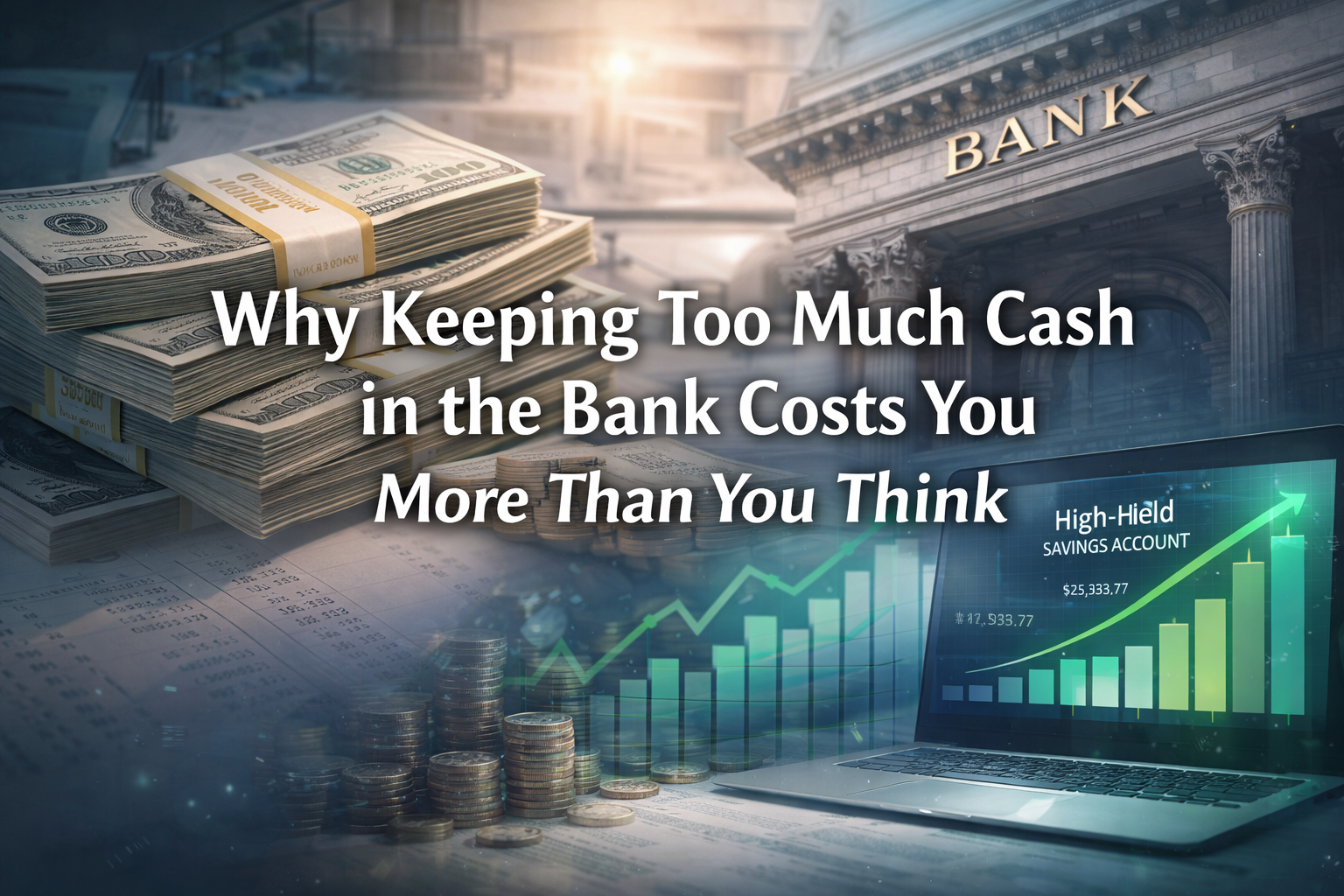
Keeping cash available can potentially provide flexibility and security. But we believe there may also be a hidden cost when substantial cash sits in an account earning very little interest.
Cash Is Still a Financial Decision
We believe choosing not to invest a particular dollar is still a financial decision. Cash may serve an important purpose, especially when it is intended for unexpected expenses or near-term needs.
The Consumer Financial Protection Bureau defines an emergency fund as “a cash reserve that’s specifically set aside for unplanned expenses or financial emergencies.” Its guide to building an emergency fund also states that the appropriate amount depends on an individual's situation. Consumer Financial Protection Bureau
We believe this distinction is important. Cash intended for an emergency may have a very different purpose from money allocated to long-term investments.
That does not mean, however, that the interest rate on your cash should necessarily be ignored.
The Hidden Cost May Be Purchasing Power
We believe inflation is one reason investors may want to pay attention to what their cash earns.
According to the U.S. Bureau of Labor Statistics' August 2026 Consumer Price Index report, the Consumer Price Index for All Urban Consumers increased 3.4 percent over the 12 months ending in August 2026. The BLS also explains on that specific page that the CPI measures changes in prices paid by consumers for goods and services. Bureau of Labor Statistics
We believe that matters because cash earning substantially less than the rate at which consumer prices are increasing may potentially lose purchasing power over time.
This does not mean we believe investors should move emergency cash into stocks simply to pursue higher returns. Market investments and emergency reserves may serve very different purposes and carry different risks.
Instead, we believe investors may want to consider whether their cash can potentially earn a more competitive rate while preserving the liquidity and protection appropriate for its purpose.
Small Differences in Interest Can Add Up
Consider a hypothetical $10,000 cash reserve.
If an account paid 0.10 percent annually, $10,000 would generate approximately $10 of interest over one year, assuming the rate remained constant and excluding taxes and compounding.
If another account hypothetically paid 3.50 percent annually under the same assumptions, $10,000 would generate approximately $350.
That is a hypothetical difference of $340.
These figures are illustrations rather than predictions or representations of currently available rates. Actual rates may change, different institutions may offer different terms, and taxes and other factors may affect actual results.
We believe the example demonstrates why an account's yield can potentially matter, even when the money is being kept in cash rather than invested.
Liquidity Should Remain Part of the Conversation
For money intended to cover unexpected expenses, we believe accessibility can be particularly important.
The CFPB states that an emergency fund is designed for unplanned expenses such as car repairs, home repairs, medical bills, or loss of income. Consumer Financial Protection Bureau
In our view, this is one reason emergency savings may need to remain readily accessible rather than being treated like a long-term investment portfolio.
We believe investors considering higher-yielding cash options should evaluate more than the advertised interest rate. It may also be appropriate to consider how quickly money can be withdrawn, whether fees or restrictions apply, and whether the account fits the reason the cash is being held.
The highest rate may not necessarily represent the most appropriate option for every person.
Understanding FDIC Insurance
We believe protection is another important consideration when evaluating cash accounts.
The Federal Deposit Insurance Corporation states on its specific Deposit Insurance at a Glance page that FDIC insurance covers checking accounts, savings accounts, money market deposit accounts, and certain other deposit products at FDIC-insured banks. FDIC
The same FDIC page states that the standard insurance amount is $250,000 per depositor, per insured bank, for each account ownership category. FDIC
It is also important to understand what FDIC insurance does not cover. The FDIC specifically lists stock investments, bond investments, mutual funds, life insurance policies, annuities, and municipal securities among products that are not covered by FDIC deposit insurance. FDIC
We believe investors should verify the protection associated with a specific account rather than assuming every financial product offered through a bank or financial institution has the same insurance.
Could a Higher-Yielding Cash Account Make Sense?
We believe a competitive savings account, money market deposit account, or another appropriate cash solution may potentially provide a better balance between earning interest and maintaining access to cash.
This does not mean everyone should move their money or continually chase whichever account advertises the highest yield.
We believe it may be more useful to consider several questions together:
- Is the money sufficiently accessible for its intended purpose?
- What interest rate is the account currently paying?
- Are there fees, minimum balances, or withdrawal requirements?
- Is the deposit eligible for FDIC insurance, and is it within applicable coverage limits?
- Does the account fit within the investor's broader financial plan?
We believe these considerations may provide a more complete picture than looking at yield alone.
What Does Cash Have to Do With Socially Responsible Investing Companies?
Someone researching socially responsible investing companies may naturally focus on stocks, funds, investment managers, and the environmental or social characteristics associated with investments.
We believe values-aligned holistic financial planning can potentially involve a broader perspective.
An investor may care deeply about the companies represented in a portfolio while also wanting the rest of their financial life to be managed intentionally. In our view, that can include decisions about savings, cash reserves, taxes, retirement planning, diversification, risk, and long-term financial goals.
We do not believe choosing socially responsible investing companies eliminates the need to consider these traditional financial planning questions. Instead, values may potentially become another consideration alongside an investor's financial objectives, risk tolerance, time horizon, liquidity needs, and individual circumstances.
Cash and Investments Serve Different Purposes
The FDIC states that deposit insurance protects money held in deposit accounts at FDIC-insured banks in the event of a bank failure. It also states that FDIC deposit insurance covers $250,000 per depositor, per FDIC-insured bank, for each account ownership category. (FDIC: Understanding Deposit Insurance) FDIC
By contrast, the FDIC explicitly states that investment products such as stocks, bonds, mutual funds, and annuities are not covered by FDIC deposit insurance. (FDIC: Deposit Insurance FAQs) FDIC
We believe that distinction reinforces why cash and investments should not necessarily be evaluated in the same way.
For someone exploring socially responsible investing companies, investing may potentially be appropriate for certain long-term objectives. Cash may be appropriate for different needs. We believe the objective should be to determine what role each part of a financial plan is intended to serve.
The Takeaway
We believe leaving cash in a traditional bank account is not inherently good or bad. The more important question may be whether that account is serving its intended purpose effectively.
Cash may potentially provide accessibility and stability, while FDIC-insured deposit accounts can provide protection within applicable limits. At the same time, we believe an account earning relatively little interest may have an opportunity cost, particularly during periods when consumer prices are rising.
At Holistic Finance, we believe a comprehensive financial strategy may involve looking beyond individual investments. For people interested in socially responsible investing companies, that may mean considering how their values relate to their portfolio while also making thoughtful decisions about cash, liquidity, risk, and long-term financial goals.
We believe every part of a financial plan should have a purpose, including the money that is not invested.
Disclosures
This material is for informational and educational purposes only and should not be construed as individualized investment, tax, or legal advice. Investing involves risk, including the possible loss of principal. Past performance does not guarantee future results. Sustainable, and ESG and values-based investment strategies may use different methodologies and may perform differently from the broader market or other investment strategies. Such strategies may also limit the securities or industries available for investment. Investors should consider their individual objectives, risk tolerance, financial circumstances, and preferences and consult with their financial professional before making investment decisions. The discussion of sustainable investing in this article is intended to describe considerations that some investors may incorporate into their investment decisions. It does not represent a specific investment strategy or guarantee that any particular investment or portfolio will satisfy an investor’s environmental, social, ethical, or other personal preferences. Advisory services are offered through Holistic Finance LLC an SEC Investment Advisor. Holistic Finance LLC is not affiliated with or endorsed by the Social Security Administration or any government agency.